Contents
Moving commercial cargo between Dubai and Oman is an important part of regional supply-chain operations for manufacturers traders distributors importers and exporters For many businesses road freight from Dubai to Oman provides a practical way to move goods directly from warehouses ports and distribution centres to customers and commercial locations in Oman However cross-border trucking involves more than loading goods onto a vehicle and sending the truck toward the destination...
Documents Required for Dubai to Oman Road Freight
Documentation is one of the most important parts of commercial cargo shipping from Dubai to Oman.
The exact requirements vary according to the commodity and customs arrangement, but the following documents are commonly relevant.
1. Commercial Invoice
The commercial invoice provides the financial and commercial details of the shipment.
It commonly contains:
- Seller information
- Buyer information
- Product description
- Quantity
- Unit value
- Total value
- Currency
- Country of origin
- HS Code where applicable
- Commercial terms
Oman Customs specifically lists a commercial invoice as one of the supporting documents used when creating a customs declaration.
The invoice information should match the customs declaration and physical cargo.
The packing list describes how the shipment has been packed.
It may include:
- Number of cartons
- Number of pallets
- Gross weight
- Net weight
- Dimensions
- Package numbers
- Product quantities
- Packing method
The packing list helps customs officers, warehouse operators and transport providers verify what is physically being transported.
For mixed or consolidated cargo, detailed packing information becomes especially important.
Country-of-origin information can be important during Oman customs processing.
Oman Customs lists manufacturer's country-of-origin documentation among the supporting documents for customs declarations.
Origin documentation can also affect whether goods qualify for particular customs exemptions or preferential tariff treatment.
Businesses should not assume that shipping goods from Dubai automatically means the products are of UAE origin.
The actual origin of the goods must be declared correctly.
Commercial goods crossing the border require the appropriate customs declaration.
In Oman, declarations are processed electronically through the Bayan System.
The declaration may include information such as:
- Importer
- Exporter
- Commodity
- HS Code
- Value
- Quantity
- Country of origin
- Transport information
- Customs regime
Accurate declaration preparation can reduce unnecessary border delays.
Every product should be classified under the appropriate customs tariff code.
Oman Customs provides an online HS Code search function as part of its Electronic Single Window system.
The HS Code can affect:
- Product classification
- Customs duty
- Permit requirements
- Customs treatment
- Restrictions
Businesses should verify the classification rather than relying only on a supplier's old shipping documents.
The shipment should also have the required road-transport documentation.
This may include information concerning:
- Transport provider
- Vehicle
- Driver
- Cargo
- Shipper
- Consignee
- Pickup location
- Delivery destination
The requirements depend on the transport arrangement and customs procedure.
Some products cannot simply cross the border using only standard commercial documents.
Oman Customs maintains a dedicated permit system and lists many commodity-specific import requirements.
Depending on the goods, additional approvals can apply to categories such as:
- Food products
- Agricultural goods
- Chemicals
- Cosmetics
- Pharmaceuticals
- Controlled equipment
- Petroleum-related products
- Other regulated commodities
For example, Oman Customs publishes specific additional documentation requirements for chemical and cosmetic product imports.
For this reason, the commodity should be checked before the truck is dispatched.
Before sending commercial cargo from Dubai to Oman, check:
- Commercial invoice
- Packing list
- Correct HS Code
- Certificate of Origin where applicable
- UAE export declaration
- Oman import documentation
- Transport documentation
- Vehicle details
- Driver documentation
- Consignee information
- Product permits where required
- Customs-value information
- Accurate package quantities
- Cargo weight
- Delivery address
- Unloading arrangements
A document check before departure is far easier than correcting a discrepancy while a truck is waiting at the border.
Businesses do not always need the same transportation method.
Two common options are Full Truckload (FTL) and Less Than Truckload (LTL).
What Is FTL?
FTL means the truck is primarily dedicated to one shipment or customer.
It can be useful when:
- Cargo volume is large
- Goods fill most of the truck
- Delivery is time-sensitive
- Cargo requires dedicated handling
- The business wants fewer intermediate stops
The truck generally moves more directly between pickup and delivery locations.
What Is LTL?
LTL allows smaller shipments from different customers to share vehicle capacity.
It may be suitable when:
- Cargo volume is small
- A full vehicle is unnecessary
- The business wants to optimize transport costs
- Delivery is less urgent
- Cargo can be consolidated safely
LTL can require more coordination because several shipments may be consolidated or distributed during the journey.
The best option depends on your shipment.
| Requirement | FTL | LTL |
|---|---|---|
| Large shipment | Excellent | Less suitable |
| Small shipment | May cost more | Often practical |
| Dedicated vehicle | Yes | No |
| Multiple customers per truck | Usually no | Yes |
| Direct movement | Usually better | May include consolidation |
| Sensitive cargo | Often preferred | Depends on goods |
| Cost sharing | No | Yes |
Businesses should consider both transport price and operational requirements rather than choosing only the cheapest method.
Customs duty is not determined simply by the fact that cargo travelled from Dubai.
Factors can include:
- HS Code
- Commodity type
- Customs value
- Country of origin
- Applicable exemption
- Preferential tariff treatment
Oman Customs provides a duty-calculation service that allows businesses to estimate customs duty using information including the HS Code, goods value, origin and applicable preferential tariff.
Oman Customs also states that customs valuation can take account of factors including the HS Code, country of origin and CIF value.
Businesses should therefore confirm the customs treatment for their particular goods before finalizing landed-cost calculations.
Some goods of genuine GCC origin may qualify for customs exemption when the applicable GCC origin requirements are satisfied.
Oman Customs states that products from GCC countries can receive customs exemption subject to the applicable rules, including purchase-invoice and origin requirements. For certain goods, specific Gulf origin documentation may also be required.
However, this does not mean that every product transported from Dubai automatically becomes duty-free.
For example, imported goods originally manufactured outside the GCC do not become UAE-origin goods merely because they were stored or re-exported from Dubai.
The correct origin and customs treatment should be established for each shipment.
This distinction is especially important for Dubai traders.
Consider two examples.
Shipment A
A product is genuinely manufactured in the UAE and meets the applicable GCC origin requirements.
It may qualify for relevant GCC customs treatment, subject to the rules and required documentation.
Shipment B
A product is manufactured in another country, imported into Dubai and later sold to a customer in Oman.
This is a different customs situation.
The product's original country of origin generally remains relevant even though Dubai is the point from which it is being shipped.
This is why customs documents should clearly distinguish between:
Country of Export and Country of Origin.
Cross-border cargo can be delayed for several reasons.
Incorrect Commercial Invoice
The invoice may contain:
- Wrong consignee
- Missing values
- Incorrect origin
- Vague descriptions
- Wrong quantities
The invoice should be checked before customs submission.
Wrong HS Code
Using an incorrect classification can affect duties and permit requirements.
Oman Customs provides official HS Code search and duty-calculation tools, making classification verification an important part of shipment preparation.
Missing Import Permit
A truck carrying regulated goods may reach the border only for customs to identify missing approval documentation.
Oman Customs operates commodity-specific permit services, so businesses should verify requirements before shipping.
Invoice and Packing List Do Not Match
If the invoice shows 100 units but the packing list or cargo shows a different quantity, customs may require clarification.
Consistency is essential.
Incorrect Country of Origin
Businesses sometimes confuse:
- Supplier location
- Export country
- Product origin
These are not always the same.
Country-of-origin information should reflect the actual goods.
Truck Arrives Before Documents
Transportation and customs paperwork should be coordinated together.
Dispatching the truck before documentation is ready can result in avoidable waiting.
Businesses can reduce many common problems with proper preparation.
1. Review the Shipment Before Pickup
Confirm:
- Cargo description
- Weight
- Dimensions
- Quantity
- HS Code
- Origin
- Destination
2. Check Oman Import Requirements
Do not assume every commodity follows the same process.
Oman Customs provides online permit and import-requirement services for businesses.
3. Prepare Customs Documents Early
Invoices, packing lists, origin documents and permits should be prepared before the truck reaches the border.
4. Use Consistent Product Descriptions
Use a clear cargo description across:
- Invoice
- Packing list
- Customs declaration
- Transport documents
5. Coordinate UAE and Oman Clearance
Cross-border logistics involves procedures on both sides.
The exporter, importer, transporter and customs representatives should have the required information before departure.
6. Make Sure the Consignee Is Ready
The Oman customer should be prepared for clearance and delivery.
Missing importer information can delay the process even when UAE export documentation is complete.
Businesses receiving international cargo through Jebel Ali Port may use Oman as the next destination.
A typical movement could be:
International Origin → Jebel Ali → Customs / Warehouse → Road Freight → Oman
Depending on the cargo arrangement, goods may first require:
- Customs processing
- De-stuffing
- Warehousing
- Cross stuffing
- Repacking
- Palletizing
- Cargo consolidation
After the shipment is prepared, it can continue by road toward Oman.
This makes it possible for businesses to use Dubai as a regional distribution hub.
Some cargo arriving through Jebel Ali cannot continue in the same container.
The goods may need to be transferred to another container or transportation unit before being sent toward Oman.
Cross stuffing may be required when:
- The shipping container must be returned
- Cargo is being consolidated
- Goods are being separated
- Transport mode is changing
- Destination has changed
- Shipment requires repacking
Careful coordination between cross stuffing, warehousing and road transportation can reduce unnecessary handling time.
Cargo does not always need to move directly from Jebel Ali to Oman.
Businesses may need temporary storage while they:
- Wait for customer orders
- Prepare customs documents
- Consolidate shipments
- Repack products
- Arrange trucks
- Prepare permits
- Divide inventory
Using Jebel Ali warehousing can give traders more flexibility.
For example:
A company may receive one large international container in Dubai.
The goods are unloaded into a warehouse.
Part of the inventory remains in Dubai.
Another part is prepared for Oman.
A third part may be shipped to another GCC destination.
This allows businesses to manage regional inventory from one central logistics location.
Companies shipping smaller quantities can use consolidation when appropriate.
Several shipments may be combined before road transportation.
This can be useful for:
- Traders
- Small importers
- Distributors
- E-commerce suppliers
- Spare-parts companies
- Retail suppliers
However, consolidated cargo must still have clear documentation for each shipment.
Invoices, consignee details, package identification and customs information should be properly organized.
Certain goods require controlled transportation conditions.
These can include:
- Food
- Pharmaceuticals
- Temperature-sensitive industrial products
- Other controlled cargo
For these shipments, businesses should confirm:
- Required temperature
- Vehicle type
- Product permits
- Packaging
- Monitoring requirements
- Border documentation
- Receiving conditions
Additional commodity-specific regulatory requirements may apply.
Oman Customs maintains permit services for regulated product categories, so these requirements should be checked before transportation.
Some specialized commodities may require additional documentation, vehicle standards, permits or regulatory approvals.
Businesses should never treat specialized cargo like ordinary general freight.
Before booking the truck, provide the logistics company with the exact commodity description and supporting technical information.
Oman Customs' permit system includes dedicated procedures for multiple regulated product categories, including certain chemical and petroleum-related goods.
There is no single guaranteed transit time for every commercial shipment.
The total movement can be affected by:
- Pickup location
- Oman destination
- Cargo type
- FTL or LTL service
- Customs documentation
- Border processing
- Inspection
- Permit requirements
- Traffic
- Receiving schedule
Businesses should therefore distinguish between driving time and the complete logistics transit time.
A truck may cover the physical distance relatively quickly, but customs and cargo-handling procedures are also part of the shipment timeline.
For time-sensitive shipments, documents should be prepared before the vehicle leaves Dubai.
When requesting a Dubai to Oman road freight quote, provide:
- Pickup location
- Oman delivery location
- Commodity
- Number of packages
- Dimensions
- Total weight
- HS Code if available
- Cargo value
- Country of origin
- Required delivery date
- FTL or LTL preference
- Temperature requirements
- Loading method
- Unloading requirements
- Whether customs support is required
Providing complete information leads to more accurate transport planning.
Before dispatching your shipment:
- Confirm pickup location.
- Confirm Oman destination.
- Select FTL or LTL.
- Confirm cargo weight.
- Confirm cargo dimensions.
- Check HS Code.
- Prepare commercial invoice.
- Prepare packing list.
- Verify country of origin.
- Prepare Certificate of Origin where applicable.
- Check UAE export requirements.
- Check Oman import requirements.
- Obtain required commodity permits.
- Confirm consignee details.
- Arrange customs clearance.
- Confirm truck and driver documentation.
- Confirm final delivery arrangements.
- Keep all shipment information consistent.
Cross-border trucking requires coordination between several stages.
Without a single logistics plan, businesses may find themselves dealing separately with:
- Warehouse
- Cargo handler
- Customs agent
- Transport company
- Border agent
- Oman consignee
Each additional handover creates another opportunity for information to be delayed or misunderstood.
An integrated logistics provider can coordinate the movement as one connected operation:
Cargo Preparation → UAE Customs → Trucking → Border → Oman Customs → Delivery
This can make cross-border logistics easier for businesses managing regular regional shipments.
Cannata Worldwide Cargo Services provides integrated UAE and GCC land transportation solutions for importers, exporters, traders and freight forwarders.
For Oman-bound shipments, logistics support can include:
- Cargo pickup
- UAE land transportation
- GCC cross-border trucking
- Customs clearance coordination
- Documentation support
- Jebel Ali cargo handling
- Cross stuffing
- Warehousing
- Cargo consolidation
- Repacking
- Palletizing
- Re-export handling
- Freight forwarding
- Delivery coordination
For cargo arriving through Jebel Ali, Cannata can also coordinate the movement from the port or warehouse into the next stage of the GCC supply chain.
Successful cross-border transportation depends on coordination.
The truck, cargo, customs documentation and consignee all need to be ready at the correct time.
Cannata combines transportation with customs clearance, warehousing and cargo-handling support, helping businesses manage several logistics requirements through one network.
Whether you need:
- A dedicated truck to Oman
- Consolidated cargo transportation
- Jebel Ali warehouse pickup
- Cross-stuffed cargo transportation
- Re-export cargo handling
- Customs support
- GCC distribution
Cannata can help coordinate the shipment from Dubai toward its final destination.
Dubai to Oman road freight is an important logistics option for businesses moving commercial goods between the UAE and Oman.
However, successful cross-border trucking depends on much more than the vehicle itself.
Businesses need accurate:
- Commercial invoices
- Packing lists
- HS Codes
- Country-of-origin information
- Customs declarations
- Product permits
- Transport documents
- Consignee information
Oman Customs processes declarations through its Bayan electronic customs system and requires supporting documentation such as commercial invoices and origin information, with additional permits applying to certain regulated goods.
Businesses should also verify customs treatment carefully because goods shipped from Dubai are not automatically UAE-origin goods, and customs exemptions depend on applicable origin and other requirements. Oman Customs publishes specific rules for qualifying GCC-origin products.
Preparing documentation before dispatch, choosing the correct truck and coordinating customs procedures on both sides can reduce avoidable delays.
Cannata Worldwide Cargo Services supports businesses with Dubai to Oman cargo transportation, GCC road freight, customs clearance, Jebel Ali warehousing, cross stuffing, cargo consolidation and re-export logistics.
Contact Cannata Worldwide Cargo Services today to discuss your UAE to Oman shipment and arrange a cross-border logistics solution based on your cargo, destination and delivery requirements.
How can I send commercial cargo from Dubai to Oman?
Commercial cargo can be transported by road using FTL or LTL services depending on shipment size. The shipment must comply with the applicable UAE export and Oman import/customs requirements.
What documents are needed to transport cargo from UAE to Oman?
Common documents can include a commercial invoice, packing list, customs declaration, HS Code information, country-of-origin documentation, transport documents and permits where required. Oman Customs lists a commercial invoice, manufacturer's country-of-origin documentation and applicable permits among documents used for customs declarations.
What is the Bayan System in Oman?
Bayan is Oman's electronic customs system used for customs-related processes including creating and submitting customs declarations.
Does Oman require an HS Code for imported cargo?
HS classification is part of the customs process. Oman Customs provides an online HS Code search service and duty calculator for traders.
Are goods shipped from Dubai duty-free in Oman?
Not automatically. Customs treatment depends on factors including the product's actual country of origin, HS classification and eligibility for any exemption or preferential treatment. Oman Customs publishes separate exemption rules for qualifying GCC-origin products.
What is the difference between FTL and LTL to Oman?
FTL generally uses dedicated truck capacity for one shipment, while LTL combines smaller shipments so businesses can share vehicle capacity.
Can I ship small cargo from Dubai to Oman?
Yes. Smaller commercial shipments may be suitable for LTL or consolidated road freight depending on cargo type, volume, customs requirements and delivery schedule.
Can cargo from Jebel Ali be transported directly to Oman?
Cargo arriving through Jebel Ali can continue toward Oman after the applicable customs, cargo handling and transport procedures have been completed.
Can I store cargo in Dubai before sending it to Oman?
Yes, depending on its customs status and logistics arrangement. Warehousing can be useful when cargo needs consolidation, repacking, documentation preparation or temporary storage before onward transportation.
Do food or chemical products need additional permits in Oman?
Certain regulated commodities require additional permits or documentation. Oman Customs maintains commodity-specific permit services, including requirements for product categories such as chemical and cosmetic goods.
How much does Dubai to Oman road freight cost?
The cost depends on shipment weight, volume, truck type, FTL or LTL service, pickup and delivery locations, cargo requirements, customs services and other handling needs. A freight quote should therefore be based on the actual shipment details.
Can Cannata handle customs and transportation together?
Yes. Cannata Worldwide Cargo Services provides integrated logistics support including customs clearance, UAE and GCC land transportation, Jebel Ali warehousing, cross stuffing, cargo handling, consolidation and re-export logistics.
Does Cannata provide Dubai to Oman road freight?
Yes. Cannata provides GCC cross-border transportation solutions and can support commercial cargo movements from Dubai and other UAE locations toward Oman as part of its regional logistics services.
The short version
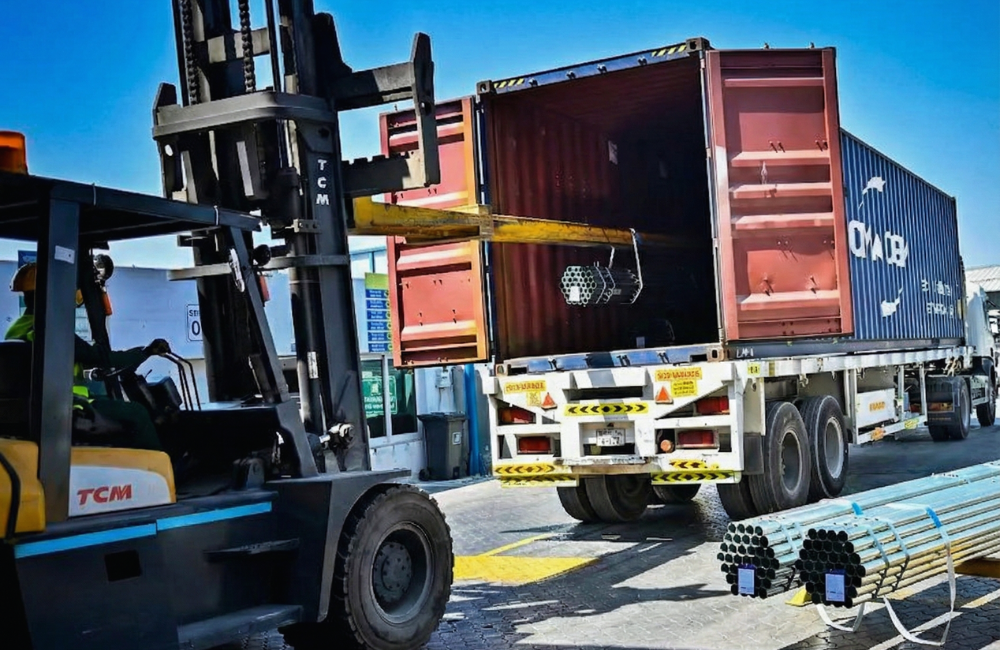
Dubai to Oman is a same-continent road move, so the cargo never sees a port. What decides whether it arrives on time is paperwork: the invoice, the packing list, the certificate of origin and the correct HS code, all agreeing with each other before the truck reaches Hatta or Al Darah.
On the road
Moving commercial cargo between Dubai and Oman is an important part of regional supply-chain operations for manufacturers, traders, distributors, importers and exporters.
For many businesses, road freight from Dubai to Oman provides a practical way to move goods directly from warehouses, ports and distribution centres to customers and commercial locations in Oman.
However, cross-border trucking involves more than loading goods onto a vehicle and sending the truck toward the destination.
The shipment may require:
- Export documentation in the UAE
- Commercial invoices
- Customs declarations
- Correct HS Codes
- Country-of-origin information
- Oman import documentation
- Commodity permits
- Border customs procedures
- Suitable truck selection
- Driver and vehicle documentation
- Final-mile delivery planning
Oman Customs operates the Bayan electronic customs system, through which customs declarations and required supporting documents are processed. Official Oman Customs guidance lists commercial invoices and country-of-origin documentation among the documents required when creating certain customs declarations, with additional permit documentation required for regulated goods.
For businesses transporting cargo regularly between the two countries, proper planning can reduce border delays, document discrepancies and unnecessary logistics costs.
This guide explains how Dubai to Oman road freight works, which documents businesses should prepare, what can delay a shipment and how professional logistics support can simplify cross-border cargo movement.
Dubai is a major logistics and distribution centre serving the UAE and wider GCC region.
Businesses may receive goods through:
- Jebel Ali Port
- Dubai warehouses
- UAE manufacturing facilities
- Free-zone facilities
- Local suppliers
- International freight shipments
From there, cargo may need to continue toward customers or distributors in Oman.
Road transportation allows businesses to move commercial cargo directly between the UAE and Oman without necessarily transferring the goods between several international transport modes.
For many shipments, this creates a straightforward logistics chain:
Supplier / Port → Dubai Warehouse → Truck → Border Clearance → Oman → Customer
Road freight can be suitable for both regular commercial distribution and individual project shipments.
A typical UAE to Oman cargo transport operation involves several stages.
Step 1: Cargo Collection in Dubai
The logistics provider collects the goods from the agreed location.
This could be:
- Jebel Ali
- A Dubai warehouse
- A factory
- A supplier
- A distribution centre
- Another UAE location
Before collection, the shipment details should already be reviewed.
Important information includes:
- Number of packages
- Cargo dimensions
- Total weight
- Commodity type
- HS Code
- Delivery location
- Required transport method
- Special handling requirements
Correct cargo information helps the transport provider select the appropriate vehicle and plan the customs movement.
Step 2: Prepare UAE Export Documentation
Commercial cargo leaving the UAE must be processed under the appropriate customs and export procedures.
Documentation should be prepared before the vehicle reaches the border.
Depending on the shipment, this can include:
- Commercial invoice
- Packing list
- Export customs declaration
- Certificate of Origin where applicable
- Transport documentation
- HS Code details
- Product permits
- Vehicle details
- Consignee information
The exact requirements depend on the cargo, its customs status and the applicable export procedure.
Businesses should therefore avoid preparing documents only after the truck has already been dispatched.
Step 3: Arrange the Correct Truck
The type of truck depends on the cargo.
Possible transportation options include:
- Full Truckload
- Less Than Truckload
- Curtain-side trucks
- Box trucks
- Flatbed vehicles
- Temperature-controlled vehicles
- Specialized cargo transport
The logistics provider should consider:
- Weight
- Volume
- Dimensions
- Packaging
- Cargo sensitivity
- Loading method
- Unloading requirements
Using the correct vehicle reduces handling problems and helps ensure the shipment can move efficiently to the consignee.
Step 4: Complete UAE Border Procedures
Before the cargo leaves the UAE, the appropriate export or customs procedure must be completed.
Shipment information should match across the documentation.
For example:
Commercial Invoice → Packing List → Customs Declaration → Cargo on Truck
All should describe the same goods accurately.
Differences in quantity, weight, HS Code, consignee or cargo description can cause customs questions.
Step 5: Complete Oman Customs Clearance
When commercial cargo enters Oman, the importer or authorized representative must complete the applicable customs declaration and clearance process.
Oman Customs states that customs declarations are created through the Bayan System, with supporting documents attached electronically.
According to Oman Customs' general customs-declaration service, required documentation includes a commercial invoice, a manufacturer's country-of-origin certificate and permits where the commodity requires them.
Additional documentation can apply depending on the product and applicable customs treatment.
Step 6: Final Delivery in Oman
After customs clearance is completed, the truck continues toward the consignee.
Delivery planning should confirm:
- Destination address
- Receiving hours
- Contact person
- Unloading equipment
- Access restrictions
- Labour availability
Good final-mile planning prevents the truck from reaching the customer before the receiving facility is ready.